CHECK THE OUTPUT
Ask for the selected indoor/outdoor combination’s heating capacity at your design conditions—not just the nominal “tonnage.”
 Call 867-447-2856
THE HOMEOWNER’S HEAT PUMP GUIDE
More comfort. Better understanding.
Discover how heat pumps work—and what matters when your winter is a northern winter.
01 / SIMPLE IDEA. SMART TECHNOLOGY.
A heat pump transfers heat using electricity and refrigerant. One system can warm your home in winter and cool it in summer. Switch modes below to see the idea in action.
Simplified illustration of heat transfer—not an installation drawing.
Even cold outdoor air contains heat. The refrigerant absorbs some of that energy, and the compressor raises its temperature so heat can be released indoors.
The reversing valve changes refrigerant flow when the system switches between heating and cooling.
02 / THE QUESTION EVERY NORTHERNER ASKS
“It runs in cold weather” and “it heats my entire home at that temperature” are different claims. A northern design checks capacity, operating limits, cost and backup heat together.

YELLOWKNIFE FIELD EVIDENCE
Arctic Energy Alliance’s 2026 report found that cold-climate heat pumps can operate in Yellowknife, with secondary heat still required in extreme cold. Operating economics change with temperature and fuel prices.
Read the local study summary ↗EXPLORE THE SEASONS
When the heating demand is lower, a heat pump may cover more of the home’s needs. In the North, milder weather can also offer more favourable operating economics.
Capacity: When does the home require more heat than the heat pump can supply?
Cost: When does another available heat source cost less to operate?
These points can differ. There is no universal switchover temperature for every home.
Operating limit: What temperature range does the manufacturer permit for this exact matched system? A minimum operating temperature does not guarantee enough heat for your home.
Ask for the selected indoor/outdoor combination’s heating capacity at your design conditions—not just the nominal “tonnage.”
Keep dependable heat available for the conditions the heat pump cannot cover. Controls must coordinate the systems.
Frost can form on the outdoor coil. Defrost clears it, producing water that needs a planned route away from trouble spots.
03 / START WITH THE HOME
Ducted and ductless describe how air is delivered. Hybrid describes how a heat pump works with fuel-fired heat. Your distribution system and backup strategy are related decisions.
WHOLE-HOME AIR DISTRIBUTION
A ducted heat pump uses compatible indoor equipment and ductwork to move conditioned air throughout the home.
A USEFUL STARTING POINT
Select an answer for questions to bring to JSL. This is a conversation starter, not equipment selection.
We’ll help you identify what to check before choosing a system.
04 / UNDERSTAND THE NUMBERS
COP compares heat delivered with electricity consumed at a particular condition. Your bill also depends on energy prices, weather, the home and backup heat operation.
Learning example only. These values are not a prediction for a particular model, temperature or northern winter.
A point-in-time efficiency ratio. It changes with conditions and equipment operation.
A standardized seasonal heating rating. Useful for comparison, but not your home’s annual bill.
A standardized seasonal cooling rating. It does not tell you winter heating capacity.
The rate of heat delivered, often in kW or BTU/h. Ask how it changes as outdoor temperatures fall.
Your current fuel and delivered price; electricity rate structure; seasonal equipment performance; home heating load; backup operation; and any added cooling use. Installation, maintenance and fixed charges also matter to total ownership cost.
A lower electricity input does not automatically mean a lower bill than another fuel. Ask for written assumptions and a range of outcomes rather than one guaranteed saving.
05 / THE DETAILS THAT MAKE THE DIFFERENCE
The equipment is one part of the job. A thoughtful plan connects the house, the installation and the way you’ll actually use it.

A heating and cooling load assessment considers insulation, windows, air leakage, layout and local design conditions. Floor area alone is not enough to size equipment.
Assess duct capacity and airflow, or the spaces each indoor head can actually serve. An electrical assessment checks supply capacity and the proposed heat pump and backup loads.
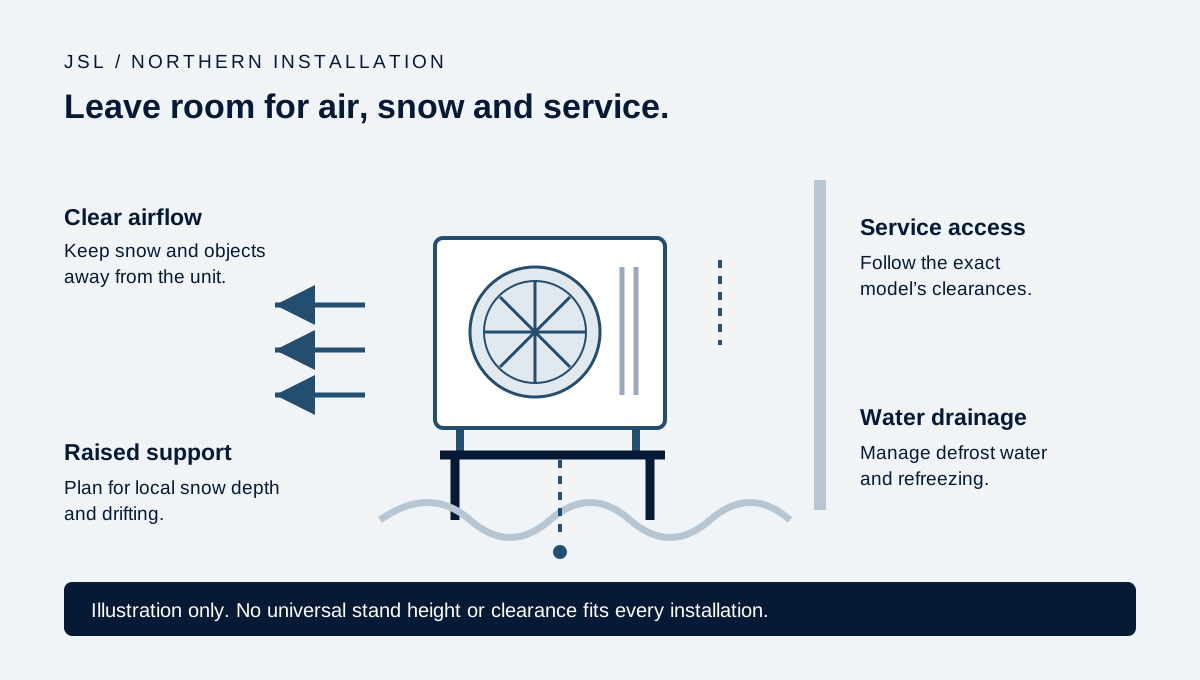
Allow manufacturer-required airflow and service clearances. Consider snow accumulation, roof shedding, wind, sound and vibration. Plan suitable supports and safe defrost drainage.
Verify the equipment combination and controls. Document when backup operates, what happens below the heat pump’s operating limit and how the homeowner should use the thermostat.
Qualified installers should check operation according to the manufacturer’s requirements. Ask for a walkthrough of controls, filters, maintenance, warranty terms and service contacts.
MAKE YOUR FIRST CONVERSATION COUNT
Tick what you have ready. Print your list and bring it to your appointment.
0 of 6 ready
Selections stay on this page only. No personal information is submitted.
EVERYDAY OWNERSHIP
Variable-capacity systems can run for longer periods at lower output. Follow the recommended thermostat strategy instead of assuming longer run time means a fault.
Brief defrost cycles, water and a visible vapour cloud can be normal. Persistent heavy ice, repeated faults or poor heat delivery deserve a service call.
Follow the manual for filter cleaning and replacement. Keep accessible airflow areas clear. Leave electrical, refrigerant and internal service work to qualified professionals.
Do not chip ice from the coil, open electrical panels or wrap an operating unit in a solid winter cover. Ask JSL how to use setbacks and backup controls with your particular system.
CLEAR ANSWERS. BETTER DECISIONS.
Practical answers for homeowners considering a heat pump in Yellowknife and the North.
It depends on the design and equipment. Local field evidence supports retaining a secondary heat source for extreme cold. Do not remove dependable backup based only on a brochure’s lowest operating temperature.
Possibly, but it is not automatic. Compare current fuel and electricity costs, your home’s demand, seasonal performance and backup operation. A heat pump can reduce energy use while costing more to run than another available fuel in some conditions.
Possibly. A furnace may work with a compatible ducted heat pump; a ductless system may complement a boiler. Equipment condition, airflow, controls and the overall design need assessment.
Not necessarily. Closed doors, room layout and heat losses affect distribution. One indoor head serving an open area does not prove every bedroom will be comfortable. A multi-zone or other distribution design may be needed.
No. Correct selection balances heating and cooling needs, capacity at relevant temperatures, modulation, airflow and backup. A bigger nominal size is not a substitute for design.
A heat pump needs electricity. Many furnaces and boilers also need power for controls, fans or pumps. Discuss an outage plan separately; retaining fuel heat does not automatically provide heat without electricity.
Sound depends on the equipment, operating speed, mounting and location. Ask about placement near bedrooms and neighbours, vibration isolation and model-specific sound information.
Programs, eligibility and funding change. Visit JSL’s Yellowknife heat-pump and rebate page for the next step, and confirm current program terms before purchasing. A listed program does not establish that your equipment or home qualifies.
LET’S LOOK AT YOUR HOME.
Bring your questions, your comfort priorities and your current heating information. Talk to JSL Mechanical about the right next step.
This homeowner guide adapts durable concepts from the supplied HP Technical Training material: heat transfer, system configurations, balance points, airflow, installation planning and commissioning. Older model specifications and historical cost examples are not presented as current offers.
Reviewed 18 October 2026. Education only; final design uses current manufacturer requirements and a qualified assessment of the actual home. Illustrations are conceptual. Equipment imagery is illustrative and is not represented as a JSL installation.
Checking analytics preference.
JSL uses Google Analytics automatically on supported public pages to measure visits, selected request and phone-link clicks, and when the service-request form embed enters view. These clicks and views do not confirm a submitted request. The careers page is measured only as a page visit. You can turn website analytics off below without a popup or form.
Google receives technical information such as your IP address, browser details, page information, referrer site and cookie identifiers. JSL’s website analytics code supplies fixed page labels, page addresses without query strings or fragments, referrer origins and a limited set of campaign labels. It does not read form contents or set user IDs. Google advertising features are disabled for this integration. When enabled, the Residential Service Request form’s separate Google Analytics integration measures form activity and completed requests. Jobber may use analytics cookies and send Google browser and other technical data, cookie identifiers, full page and referral URLs, and campaign details. This integration operates independently of JSL’s website analytics code. Turning website analytics off in Privacy settings does not turn off Jobber’s own analytics. We have not verified whether Jobber independently respects Global Privacy Control.
Your website analytics preference is saved separately from marketing. A saved analytics off choice remains until you change it or clear this site’s browser data. JSL’s website analytics code respects existing analytics refusals and Global Privacy Control. Website analytics stays off if the preference cannot be reliably stored. Turning it off disables further measurement by JSL’s controller and attempts to remove its accessible first-party analytics cookies; it does not erase information Google already received. JSL’s website analytics cookies are configured for up to 180 days without extending that lifetime on subsequent events. See Google’s privacy policy.
Marketing tracking is off.
If you allow marketing tracking, Meta Pixel measures page visits and selected campaign clicks to help measure and improve JSL’s Facebook and Instagram advertising. Meta receives technical information such as your IP address, browser details, page URL, referrer and cookie identifiers, and may link this with your Meta account.
JSL’s tracking code does not send form contents or supply advanced-matching data. Website analytics has separate controls above. You can turn marketing tracking off here at any time. Turning it off stops future tracking by this integration and attempts to remove its accessible first-party cookies; it does not erase information Meta already received.
Your choice is stored in this browser for up to 180 days. If storage is blocked, it applies only to this page. See JSL’s privacy policy and Meta’s privacy policy.